
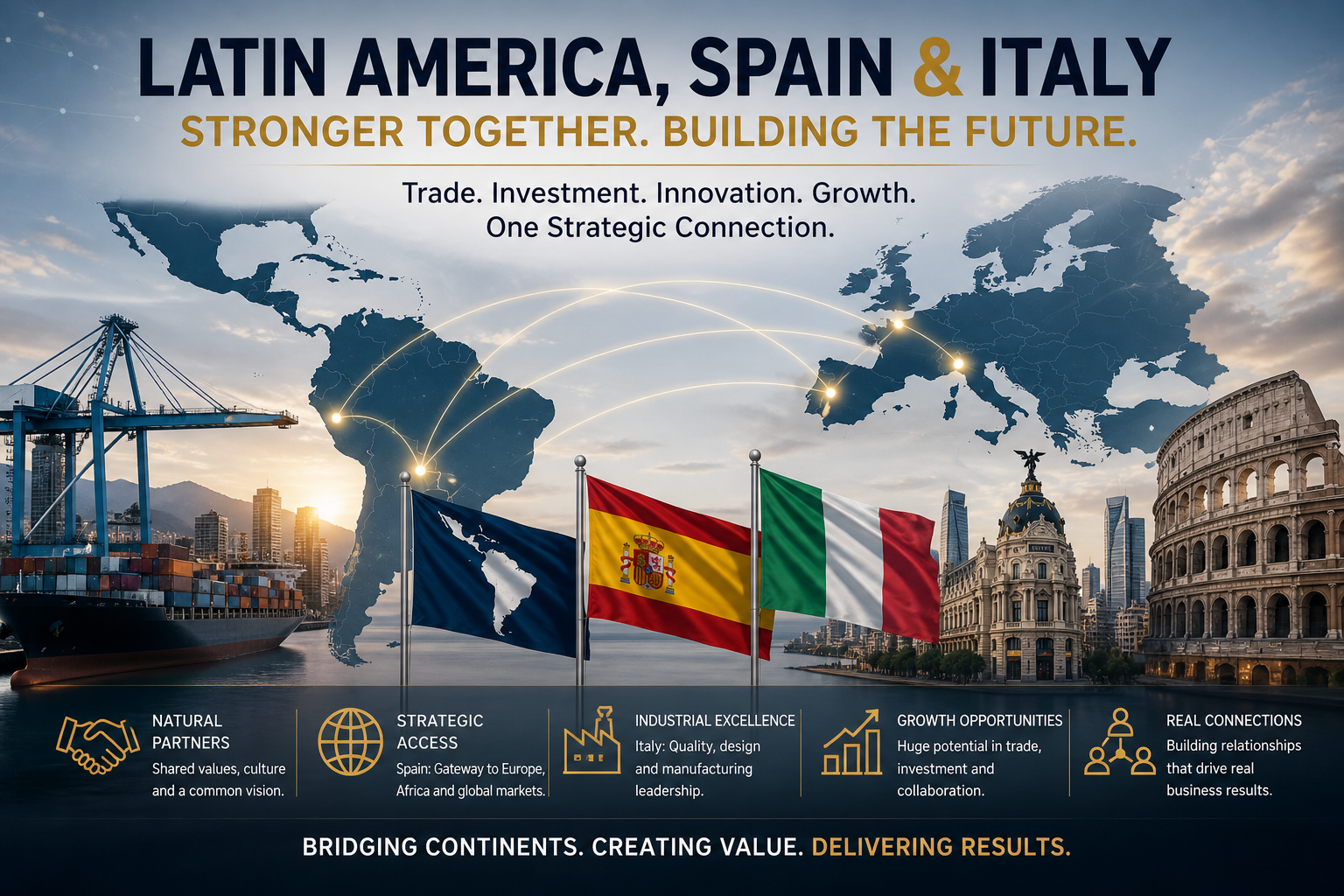
The integration of Latin America with Spain and Italy is not just a historical or cultural concept—it is one of the most underutilized economic opportunities in today’s global landscape. While the world is increasingly fragmented by geopolitical tensions, tariffs, and competing blocs, there is a natural, strategic bridge that already exists across the Atlantic—and most businesses are not leveraging it properly.
Trade and investment flows between Europe and Latin America are not theoretical—they are massive and growing. In 2022 alone, exports between the European Union and Latin America reached historic levels, with over 158 billion USD in exports from Europe to the region and more than 160 billion USD flowing in the opposite direction. Within that dynamic, countries like Spain and Italy play a critical role as key commercial gateways. (CEOE)
Spain, in particular, has positioned itself as one of the most important economic connectors between both regions. It is currently the second-largest investor in Latin America globally, only behind the United States, and at the same time receives significant investment flows from Latin American companies. (Banco de España) This is not accidental—it reflects decades of business integration, shared language, legal familiarity, and operational ease.
But here’s where it gets more interesting.
Spain is no longer just a partner—it is a platform.
Today, hundreds of Latin American companies are using Spain as a strategic base to expand into Europe, Africa, and beyond. This “gateway effect” is accelerating, driven by infrastructure, regulatory alignment with the European Union, and access to capital markets. (El País)
Italy, on the other hand, plays a complementary but equally important role. As one of the largest exporters within the European Union to Latin America, particularly in industrial goods, machinery, and specialized manufacturing, Italy represents the production and industrial backbone of this transatlantic relationship. (CEOE)
When you connect the dots, the opportunity becomes obvious:
Latin America provides resources, growth markets, and emerging demand.
Spain provides access, structure, and financial integration.
Italy provides industrial capacity, design, and manufacturing expertise.
That combination is not common. And more importantly—it is not fully exploited.
The real problem is not lack of connection—it is lack of execution.
Despite the scale of trade and investment, Latin America still operates with fragmented strategies, weak regional coordination, and limited long-term positioning in global value chains. This lack of integration reduces its ability to negotiate, scale, and compete effectively on a global level. (El País)
At the same time, Europe is actively looking to diversify its economic relationships. With increasing tension between major global powers, strengthening ties with Latin America is no longer optional—it is strategic.
There is even strong evidence that deeper integration between both regions could dramatically increase economic activity. Some estimates suggest that a fully integrated economic space between Europe and Latin America could increase trade flows by up to 70%, unlocking a completely new level of commercial interaction. (Real Instituto Elcano)
So why isn’t this happening faster?
Because integration does not happen at the macro level first—it happens at the deal level.
Governments can sign agreements. Institutions can promote cooperation. But real integration is built through companies that:
identify opportunities
structure relationships
align incentives
and actually execute deals
And this is exactly where most businesses fall short.
They understand the opportunity.
They explore the market.
They make contacts.
But they don’t structure properly.
They don’t move with speed.
They don’t close.
The Spain–Italy–Latin America triangle is not a theory—it is an execution opportunity. It is about building real supply chains, real partnerships, and real commercial flows that connect production, distribution, and market access across regions.
This is especially relevant in sectors like food and agriculture, energy, infrastructure, manufacturing, and consumer goods—where Latin America has supply capacity, and Europe has distribution, branding, and regulatory access.
The companies that understand this dynamic early will position themselves ahead of the curve. They will not just trade—they will integrate. They will not just explore—they will execute.
Because in the end, integration is not about agreements between countries.
It is about deals between companies.
And those who move first, move faster, and structure better… are the ones who capture the real value.